Interpreting the body language and rhetoric here, it is clear that the owners are vanquished and the players are victorious. Just listen to Don Garber's stilted, prepared corporate remarks compared to Union President Bob Foose, and the others from the union who have to hide their glee.
March 20, 2010 will go down as a great day in the history of the MLS, U.S. soccer, and the struggle for workers' rights.
Showing posts with label Don Garber. Show all posts
Showing posts with label Don Garber. Show all posts
Sunday, March 21, 2010


Saturday, March 20, 2010
Breakthrough in MLS Impasse: Deal Announced Saturday Afternoon
 By El Chupacabra
The New York Times is reporting:: "Major League Soccer and the union that represents its players announced a new five-year collective bargaining agreement after marathon negotiating sessions under the auspices of a federal mediator in Washington. The announcement came early Saturday afternoon on a conference call."
The Washington Post reports that the owners agreed to a "re-entry draft" for players out of contract at the conclusion of the season.
Wednesday, March 17, 2010
Rhetoric in MLS Labor Strife Heats Up: Owners Piss Themselves
The war of rhetoric continued to heat up today just 5 days short of the strike deadline, with MLS owners rattling their sabers, putting lifts in their shoes, and fluffing up the comb-overs on their puny, greedy heads.
 "I just hope the players understand the implication of the threats they're making to strike because if they do in fact go on strike, then that forces the owners to do something very aggressive and very different," Real Salt Lake owner Dave Checketts told the Desert News.
Having been exposed in the national soccer community as frauds, the owners clearly have calculated that fear-mongering is the only tool available to them in their quest to force the players into submitting to another collective bargaining agreement that holds the latter as indentured servants.
"I've always said that 'MLS' stands for Major League Slavery," said World Football Daily's Steven Cohen.
Just picture Checketts stuttering, sweating and blinking rapidly as he says the following: "I just came from a meeting with several owners and the commissioner down here in Los Angeles, and we know exactly what we'll do. These are all owners who've been in the NBA, they've been in the NHL, some of them own Major League Baseball teams even today. We know what we'll do. We have a plan if the players strike."
If that "plan" involves bringing in scabs to play "games" owners think "fans" will pay money to watch, then they are higher than a Blues Traveler fan at Bonarroo.
Lest you conclude that Checketts is a lone voice crying out in the wilderness, witness Seattle Sounders Kingpin Joe Roth's hysterical statement to the Seattle Times: “From an entertainment standpoint, we haven’t made enough of an imprint on the national psyche," he said as he pissed himself. "I don’t think there will be a national outcry like with the NFL if somehow we wouldn’t be out there for a year – which would be terrible. Everyone would lose their jobs. We would all lose our franchises. And that would be that."
But as LA Galaxy, Everton and USMNT star Landon Donovan pointed out this week to ESPN, the players are not trying to destroy the economics of the league. Said Donovan: "I think we've made it clear from the beginning that we're not into the idea of bankrupting the league and asking for tons of monetary increases. We just want basic rights other players around the world get."
"There are realities to the business that we're in and unfortunately for too long the business has been one-sided," Donovan continued. "We need basic rights if we're going to continue playing. We want rights that are afforded to other players in other countries around the world that we don't have here."
From the earliest days of the labor movement, the first tactic owners consistently have employed is fear. Early 20th-century coal operators smeared strikers with accusations that foreign communists were behind their efforts to achieve fair wages and working conditions, using words like "insurrection" and "Bolshevik revolution" to describe strike threats. Oftentimes, physical violence accompanied the heated rhetoric. Today, MLS owners have only words as empty as their stadiums will be if they try to stage scab matches.
As Jimmy Reed said: "Big boss man, can't you hear me when I call? Big boss man, you ain't so big, you just talk, and that's all."

Having been exposed in the national soccer community as frauds, the owners clearly have calculated that fear-mongering is the only tool available to them in their quest to force the players into submitting to another collective bargaining agreement that holds the latter as indentured servants.
"I've always said that 'MLS' stands for Major League Slavery," said World Football Daily's Steven Cohen.
Just picture Checketts stuttering, sweating and blinking rapidly as he says the following: "I just came from a meeting with several owners and the commissioner down here in Los Angeles, and we know exactly what we'll do. These are all owners who've been in the NBA, they've been in the NHL, some of them own Major League Baseball teams even today. We know what we'll do. We have a plan if the players strike."
If that "plan" involves bringing in scabs to play "games" owners think "fans" will pay money to watch, then they are higher than a Blues Traveler fan at Bonarroo.
Lest you conclude that Checketts is a lone voice crying out in the wilderness, witness Seattle Sounders Kingpin Joe Roth's hysterical statement to the Seattle Times: “From an entertainment standpoint, we haven’t made enough of an imprint on the national psyche," he said as he pissed himself. "I don’t think there will be a national outcry like with the NFL if somehow we wouldn’t be out there for a year – which would be terrible. Everyone would lose their jobs. We would all lose our franchises. And that would be that."
But as LA Galaxy, Everton and USMNT star Landon Donovan pointed out this week to ESPN, the players are not trying to destroy the economics of the league. Said Donovan: "I think we've made it clear from the beginning that we're not into the idea of bankrupting the league and asking for tons of monetary increases. We just want basic rights other players around the world get."
"There are realities to the business that we're in and unfortunately for too long the business has been one-sided," Donovan continued. "We need basic rights if we're going to continue playing. We want rights that are afforded to other players in other countries around the world that we don't have here."
From the earliest days of the labor movement, the first tactic owners consistently have employed is fear. Early 20th-century coal operators smeared strikers with accusations that foreign communists were behind their efforts to achieve fair wages and working conditions, using words like "insurrection" and "Bolshevik revolution" to describe strike threats. Oftentimes, physical violence accompanied the heated rhetoric. Today, MLS owners have only words as empty as their stadiums will be if they try to stage scab matches.
As Jimmy Reed said: "Big boss man, can't you hear me when I call? Big boss man, you ain't so big, you just talk, and that's all."
Sunday, March 14, 2010
The Mysteries of the MLS Labor Showdown
By Nordecke Luchador
Tune in this Tuesday to World Football Daily with Stephen Cohen and Kenny Hassan, when the head of MLS Solidarity will expose Don Garber, Mark Abbott and the other suits in the MLS front office for the soulless, shortsighted, corporate thugs that they are. The specific time will be announced Monday. As the Nordecke Luchador prepares to face the U.S. Soccer Nation, he offers this blog post to put the current labor struggle into perspective.
The Three Mysteries of the MLS Labor Showdown:
The Three Mysteries of the MLS Labor Showdown:
Mystery No. 1: What does the league want? Commissioner Garber has spoken in Orwellian Doublespeak from the beginning, saying such nonsense as: "We remain hopeful" and "We will not agree to any deal that compromises the long-term viability of the league." But the league bosses have never once explained exactly why they believe the league cannot give the majority of players guaranteed rather than "semi-guaranteed" contracts and keep the league economically viable. "Semi-guaranteed" means nothing. The current structure is so slanted in favor of the owners that it is an international embarrassment.
Mystery No. 2: Where is the Union leadership? At a time when they clearly should be making their case forcefully and vocally, the Players Union has been silent. Sure, both the league and the players have agreed to a gag order imposed by Federal Mediator George H. Cohen, but there are ways around such an order that a savvy union could use to make their case to the public. The home page for the MLS Players Union lists this top "news" item: Chicago Fire sign Dutch Player Collins John. There is nothing on the site about the most important moment in the history of the league, the union and perhaps American soccer history. The Union doesn't even acknowledge that there is a dispute and explain why they can't talk. The most recent "news release" is an Aug. 14,2008, statement about the SuperLiga. .

So kudos to Toronto FC defender Nick Garcia who broke the silence last week when he said he expects the players to strike if a new collective bargaining agreement is not negotiated before the start of the regular season. Article Here.
But it remains a mystery why Bob Foose and the other union leaders don't find ways to garner more public understanding and support for their cause. If the public understood just how poorly the players are treated by the current CBA relative to every other major sports league, they might understand that this isn't a battle between million dollar athletes and million dollar owners. This is about a league that wants to maintain the status quo and continue to treat the product on the field (the labor) as second class citizens.
Union President Bob Foose and the players are working to alter the structure of MLS player contracts. The current agreement offers few guaranteed contracts and "semi-guaranteed" contracts are anything but a legal, binding set of obligations by the league as they allow the team bosses to cut players before July 1 without having to fullfill their obligation under the terms of the original agreement
Equally important there is no free agency, so a player who gets cut by the single-entity league has virtually no chance to seek employment on another team. After players are released their teams retain their rights which forces other teams to trade for those rights if they want to sign that player. This makes it very difficult for the players to negotiate in order to find a new home. As such, they don't even own their own labor, which in this case is the talent they bring to the field as one of the best soccer workers in the entire US. Remember, they aren't cut by their team per se, they are cut by the entire league. This is tantamount to a worker at GM being fired and then prevented from taking his skills over to Ford. In the rest of the working world it's called collusion, and it's unconstitutional and about as American as Vietnam, Halliburton and the River Rouge Massacre. The end result is that players are entangled in options that maximize the power of the league over individual players to an extent that no American worker would tolerate.
The whole system is highly exploitive of lower-level players who are left with sweatshop wages and no measure of control over their careers. (Keep in mind, for example, that the Crew's Steven Lenhart’s base salary in 2009 was less than $34,000. This was a huge increase over his 2008 salary of $12,900 when he was on the developmental squad, but hardly the wage of someone whose skills place him in the top 1% of all American soccer workers). For more on MLS salaries, read this article from the Luchametric archive.
All the union wants is a collective bargaining agreement that is consistent with US sport economics and US labor values and that abides by the same rules as the rest of the soccer planet under FIFA.
For a detailed analysis of the many injustices built into the present system by the MLS, read this article by the Houston Chronicle's Jose De Jesus Ortiz.
Mystery No. 3: Who are the scabs? Reports have been inconsistent on the exact number of players who voted to strike last week. Steven Goff reported in his Soccer Insider "Blog" that the vote was 350-2. ESPN's Jeff Carlisle and other sources have reported the vote was 383-2. But no one has denied the story that the players voted overwhelmingly to strike if a deal is not reached by 12:01 March 23. And all reports are that there were only two dissenters. MLS Solidarity is working its networks to uncover the names, and when discovered they will be reported at www.Luchametric.com.
There are two sides to every struggle: What side, you on?
Saturday, March 13, 2010
MLS Solidarity Sets Clock, Issues Edict
The fan group MLS Solidarity today added a countdown timer to its Web site to remind the U.S. soccer community and the capitalist money-grubbers in MLS management that time is running out to make a deal and save the season.
"Don Garber, Mark Abbott and the other bosses at MLS need to wake up and realize that we are dangerously close to the brink here," said MLS Solidarity Presidente Nordecke Luchador. "The clock is ticking for them to come to the table honestly."
 The group has a Facebook page and an underground network of players and operatives within MLS. In addition to the countdown clock, MLS Solidarity issued the following edict:
We the fans of Major League Soccer call on the management of the league to finally abandon their dishonest, selfish position and come to the negotiating table in good faith. We stand in solidarity with the players, and we stand ready to support them by any means necessary.
"Don Garber, Mark Abbott and the other bosses at MLS need to wake up and realize that we are dangerously close to the brink here," said MLS Solidarity Presidente Nordecke Luchador. "The clock is ticking for them to come to the table honestly."

We the fans of Major League Soccer call on the management of the league to finally abandon their dishonest, selfish position and come to the negotiating table in good faith. We stand in solidarity with the players, and we stand ready to support them by any means necessary.
Multiple sources report that the players on Friday voted 383-2 to go on strike if a deal is not reached by 12:01 Eastern Time on March 23.
The union's collective bargaining agreement has expired, and league management have indicated they would be willing to start the season March 23 under the terms of the expired agreement. By voting to strike, the players have called the managers' bluff.
"They have not been negotiating in good faith, and we needed to show that we are united and serious," one player told MLS Solidarity. "We will not blink. If there's no agreement, we strike. Period."
Negotiators met twice this week with a federal mediator in Washington but the players moved no nearer their goals of more guaranteed contracts and greater free agency opportunities.
"The meetings this week were productive and we scheduled a number of additional meetings," MLS president Abbott lied to the Associated Press.
Remaining business for the group includes outing the 2 scabs who voted not to strike.
Monday, March 8, 2010
Group Formed to Support MLS Players Union
In less than 24 hours nearly 100 people have signed on to a Facebook group formed to support the MLS Players Union in their struggle to achieve economic justice against the exploitive labor practices of the International House of Soccer (AKA Major League Soccer).
 The Nordecke Luchador formed the group MLS Solidarity to show which side the fans are on.
"League bosses Don Garber and Mark Abbott (pictured at left) need to see that the fans will not tolerate the continued exploitation of the players," El Luchador said in a written statement. "We in Crew Soccer Nation call on our brothers and sisters in other Fandoms to step up, join our group and demonstrate where they stand. The old union cry is as true today as it was 50 years ago: 'Which Side Are You On?'"

"League bosses Don Garber and Mark Abbott (pictured at left) need to see that the fans will not tolerate the continued exploitation of the players," El Luchador said in a written statement. "We in Crew Soccer Nation call on our brothers and sisters in other Fandoms to step up, join our group and demonstrate where they stand. The old union cry is as true today as it was 50 years ago: 'Which Side Are You On?'"
For a detailed analysis of the many insustices built into the present system by the MLS , read this article by the Houston Chronicle's Jose De Jesus Ortiz.
Saturday, March 6, 2010
Don Garber's Own Words Deceive Him
What the MLS Commissioner never explains here is this: Why does the continued growth of the league depend on not honoring players' contracts? Why can't we honor players' contracts and still have economic success for the MLS?
Thursday, November 5, 2009
The Logic of a Single Table for MLS: Garber Doesn't Get It
By El Chupacabra
If you saw the interview with MLS Commissioner Don Garber on Fox Soccer Fone-In on Monday, you saw him respond to a question about implementing a Single Table for the MLS (listen to it here). His response was, and I paraphrase, that he doesn't "get it." His argument is that a single table would make games at the end of the season meaningless.
Said Garber (and I quote): "The Columbus Crew would have won 10 days before the end of the season. They would have been celebrating the championship at a game where they lost.
“I understand the heritage and tradition that people enjoy with a single table. But somebody would have to explain to me how that would be better than what we have now, because I’m not getting it."
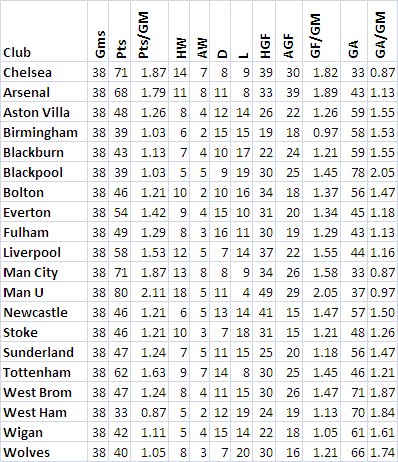
Garber's logic is flawed in a few key ways. First and foremost, a single table does not preclude a playoff system. The FIFA tournaments and the UEFA Champions League use a group system and then a knock-out round. One could argue that the current MLS arrangement with two conferences and then a play-off is similar. However, the MLS playoff system as it currently stands takes the top two teams from each group (conference) and then the next four best teams regardless of group (conference). This arrangment essentially amounts to letting the top eight teams in a single table into a knock-out round, which the International House of Soccer calls the MLS Cup. What's worse, the MLS system lets in half of the teams in the league. This year, Real Salt Lake had more losses than wins and amassed a mere 40 pts over the course of the season. The average number of points earned in the league this year was 40.4.
El Chupa agrees that the games at the end of the season should have meaning. But this desire needs to be balanced with the logic of sport--and the logic of logic.
If the purpose of any competition is to determine who is the best team, then clearly the team that does the best over time is the best team. Period. The MLS system allows teams which are clearly inferior a shot at knocking off a better team in a short series. Anything can and will happen in a short home and away series. Rubin Kazan just "won" a home and away series over Barcelona. Yesterday in the frigid cold of Kazan's Central Stadium, Rubin kept six defenders back and essentially played for the draw, stifling Barca's vaunted offensive machine who all looked like they were literally freezing their asses off. Is Rubin a better team than Barca? Hardly. Barca will still most likely make it out of their group along with Inter, and the Russian Premier League champions will end up in the UEFA Europa competition. This is as it should be, as the group stage gives teams the chance to recover from upsets, thus insuring that only the very best teams make it through to the knock-out round
Now, don't El Chupa wrong, he loves it when an underdog sticks it to a better team. It makes for great sport. But such drama doesn't belong in a knock-out round where the true underdogs have no place. In a sound system, the inferior teams will have been eliminated. But in the MLS playoff system, teams that are not even AVERAGE get a shot at being a spoiler, as they aren't eliminated in the "group stage" (regular season).
Garber also spoke of American "sporting traditions and heritage." Um, by this does he mean he wants the International House of Soccer to follow in the footsteps of the NBA and the NHL, where bad teams get rewarded with a playoff spot for monetary reasons only? The NBA system is a joke. But even in the NBA, the first round is seven games, which make it a legitimate test. If the MLS had a three-game knockout round, it would be one thing. But the current system, which doesn't weight away goals like the UEFA competitions, doesn't do justice to the logic of a sport which demands its own distinct and reasonable means of determining not just the winner of individual competitions, but the best team over the course of several competitions.
Yes, some times the best team doesn't win. And that's what makes sport exciting. But the International House of Soccer is clearly going for entertainment value over competitive legitimacy.
We love the NCAA Men's Basketball Tournament, where Cinderella teams routinely make runs into the Sweet Sixteen--but generally no further and RARELY into the final four. And we certainly think it's the case that truly great teams need to step it up in high pressure situations. But there have to be limits. And we think the current MLS system is unbalanced in favor of sports-O-tainment and of the business of sport. We like salary caps and revenue sharing. We think the European leagues are unbalanced and less interesting than American leagues like the MLS and the NFL where smaller-market teams actually have a chance of being champion. But the fact is: Garber just doesn't get it.
The solution? A single table with a revamped playoff system that reduces the number of teams which make it to the knock-out stage with the compensation of participation in international competitions based on ranking in the single table. Major League Soccer Rumors offers a very interesting possibility here, and it's one El Chupa endorses. Researching this article has resulted in a dismaying number of douche-bags in the blogo-sphere, including Brian Strauss and Paul Pabst, who also don't get it, and who clearly are coming from a rather provincial perspective that bristles rather xenophobically at the infatuation American soccer fans have with the European leagues. To Pabst's credit, he misses only the obvious point that a single table doesn't preclude a playoff system nor is Pabst anti-European. Strauss is just, well, a douche.
If you can track down Garber's email (I failed), send him a note reminding him that as long as MLS continues to cater to American sports fans rather than American soccer fans, the MLS will remain the joke it is in the world of International Pancakes--er, I mean football.
If you saw the interview with MLS Commissioner Don Garber on Fox Soccer Fone-In on Monday, you saw him respond to a question about implementing a Single Table for the MLS (listen to it here). His response was, and I paraphrase, that he doesn't "get it." His argument is that a single table would make games at the end of the season meaningless.
Said Garber (and I quote): "The Columbus Crew would have won 10 days before the end of the season. They would have been celebrating the championship at a game where they lost.
“I understand the heritage and tradition that people enjoy with a single table. But somebody would have to explain to me how that would be better than what we have now, because I’m not getting it."
Garber's logic is flawed in a few key ways. First and foremost, a single table does not preclude a playoff system. The FIFA tournaments and the UEFA Champions League use a group system and then a knock-out round. One could argue that the current MLS arrangement with two conferences and then a play-off is similar. However, the MLS playoff system as it currently stands takes the top two teams from each group (conference) and then the next four best teams regardless of group (conference). This arrangment essentially amounts to letting the top eight teams in a single table into a knock-out round, which the International House of Soccer calls the MLS Cup. What's worse, the MLS system lets in half of the teams in the league. This year, Real Salt Lake had more losses than wins and amassed a mere 40 pts over the course of the season. The average number of points earned in the league this year was 40.4.
El Chupa agrees that the games at the end of the season should have meaning. But this desire needs to be balanced with the logic of sport--and the logic of logic.
If the purpose of any competition is to determine who is the best team, then clearly the team that does the best over time is the best team. Period. The MLS system allows teams which are clearly inferior a shot at knocking off a better team in a short series. Anything can and will happen in a short home and away series. Rubin Kazan just "won" a home and away series over Barcelona. Yesterday in the frigid cold of Kazan's Central Stadium, Rubin kept six defenders back and essentially played for the draw, stifling Barca's vaunted offensive machine who all looked like they were literally freezing their asses off. Is Rubin a better team than Barca? Hardly. Barca will still most likely make it out of their group along with Inter, and the Russian Premier League champions will end up in the UEFA Europa competition. This is as it should be, as the group stage gives teams the chance to recover from upsets, thus insuring that only the very best teams make it through to the knock-out round
Now, don't El Chupa wrong, he loves it when an underdog sticks it to a better team. It makes for great sport. But such drama doesn't belong in a knock-out round where the true underdogs have no place. In a sound system, the inferior teams will have been eliminated. But in the MLS playoff system, teams that are not even AVERAGE get a shot at being a spoiler, as they aren't eliminated in the "group stage" (regular season).
Garber also spoke of American "sporting traditions and heritage." Um, by this does he mean he wants the International House of Soccer to follow in the footsteps of the NBA and the NHL, where bad teams get rewarded with a playoff spot for monetary reasons only? The NBA system is a joke. But even in the NBA, the first round is seven games, which make it a legitimate test. If the MLS had a three-game knockout round, it would be one thing. But the current system, which doesn't weight away goals like the UEFA competitions, doesn't do justice to the logic of a sport which demands its own distinct and reasonable means of determining not just the winner of individual competitions, but the best team over the course of several competitions.
Yes, some times the best team doesn't win. And that's what makes sport exciting. But the International House of Soccer is clearly going for entertainment value over competitive legitimacy.
We love the NCAA Men's Basketball Tournament, where Cinderella teams routinely make runs into the Sweet Sixteen--but generally no further and RARELY into the final four. And we certainly think it's the case that truly great teams need to step it up in high pressure situations. But there have to be limits. And we think the current MLS system is unbalanced in favor of sports-O-tainment and of the business of sport. We like salary caps and revenue sharing. We think the European leagues are unbalanced and less interesting than American leagues like the MLS and the NFL where smaller-market teams actually have a chance of being champion. But the fact is: Garber just doesn't get it.
The solution? A single table with a revamped playoff system that reduces the number of teams which make it to the knock-out stage with the compensation of participation in international competitions based on ranking in the single table. Major League Soccer Rumors offers a very interesting possibility here, and it's one El Chupa endorses. Researching this article has resulted in a dismaying number of douche-bags in the blogo-sphere, including Brian Strauss and Paul Pabst, who also don't get it, and who clearly are coming from a rather provincial perspective that bristles rather xenophobically at the infatuation American soccer fans have with the European leagues. To Pabst's credit, he misses only the obvious point that a single table doesn't preclude a playoff system nor is Pabst anti-European. Strauss is just, well, a douche.
If you can track down Garber's email (I failed), send him a note reminding him that as long as MLS continues to cater to American sports fans rather than American soccer fans, the MLS will remain the joke it is in the world of International Pancakes--er, I mean football.
Subscribe to:
Posts (Atom)



 The Luchametric is a



 Posts
Posts